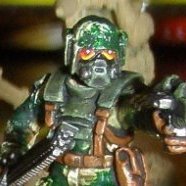
Bonehead Posted May 4 Share Posted May 4 (edited) During the height of the Augustine crusade, the many regiments of the Imperial Guard that formed the crusade's backbone forged their reputations by their successes- most notably the many 'Extraordinaries', such as the Tenstar Greycores and the various Baltan Armoured regiments. Many, like the 38th Yantar and the 4th Hoptor did not outlive the forging of those reputations. Still others merely met their fates in the worlds of the Red Hand Dominate. But not all the reputations made during the Imperial push to dethrone the heretic Xiah Hesh and bring the Red Hand's homelands to compliance were made on the side of the Imperium. The Cyng of Shatterbrow's Armour Brigades put the lie to the crusade's notions of superiority with their devastating counter-assaults on loyalist strongholds. The Vrag-Rana, Hesh's fanatical, indomitable elite commandos, enacted a strategy of unpredictable and viciously cruel geurilla actions that were as professionally efficient and effective as they were demoralising and intimidating for loyalist units, earning the Vrag-Rana the status of the Crusade forces' most dreaded and lamented foes. Desertions increased dramatically in any theatre the Vrag-Rana were known to occupy, and even the rumour of their presence was a blow for Imperial morale. The forces of Cardinal Qi on Ynworm delivered a devastating blow to the Imperials in the disastrous Yranus Landings. During the activation of the unplanned stop-gap measure that was the crusade's Tenth Army, the 'Immortals' cult seized supply depots and the tertiary starport on the previously solidly Imperial Ketrine III. The cultists lacked proper leadership or support and were rapidly dealt with, but their mere presence on a world never considered part of the Red Hand Dominate confounded Imperial commanders and changed the face of the crusade for the entire Tenth Army. Despite the Red Hand Dominate not having anything like a traditional political structure in the vein of the imperium, Xiah Hesh commanded many forces fully akin to Imperial Guard regiments, and with a similar level of professionalism and capability. The 'Mari Landsknechts' was the title proclaimed by several dozen such units, apparently from the eponymous Mari- a world notable chiefly for being still unknown to the imperium, and certainly not actually within the Red Hand Dominate. The Mari units all featured a uniform armament and appearance, displayed some of the more visible mutations among the heretical forces faced by the Crusade, speaking volumes of the depth and entrenchment of their heresy, and also displayed a level of determination, discipline and ferocity that severely outmatched several Imperial regiments. Simply by the dint of their sheer numbers, Mari forces became the de facto regular heavy infantry template of the Red Hand and the various Mari regiments' increasingly veteran status meant that their effectiveness grew at the same pace as the Crusade's own forces gained experience and capability. Moreover, the Mari forces included a number of fully equipped and supported armoured regiments, who thoroughly earned a reputation for hellishly effective aggressive actions, most often aimed squarely at Imperial forces attempting a first landing on a world: the notorious 'tolling drop' of the Tenth Army on Ardent cost the Crusade almost a dozen regiments either wiped out or so mauled they were merged into other units. But the force the Tenth Army came to despise the most was a different one. All five Armies of the Crusade -the First, Second, Third, Fourth and Tenth- faced regiments of the Kur Guards, Kur itself being a core world of the Red Hand and its Lugal being one of Xiah Hesh's chief lieutenants. All suffered for it, but none faced as many as the Tenth. The Tenth army contained none of the celebrated 'Extraordinaries' and in hard numbers was barely a third the size of any other Army, being raised in a semi-desperate ad-hoc fashion as a reaction to the discovery of the Bract Corridor, a previously unknown route into and therefore also out of the Red Hand Dominate. Essentially a plug created to prevent an outflanking manouevre, it was composed of a mixture of experienced veterans like the Ebla 45th and several regiments of Loxar Dragoons, all the way to completely green new regiments like the Yantar 8th, 14th and 38th and the 4th Hoptor. As the Tenth Army began to apply pressure on the Red Hand's rimward flank, it met fierce, sustained resistance- resistance which simply never eased. Every world, campaign, offensive and operation was a slog against equally capable resistance, and only the Crusade forces' advantages in numbers and resupply permitted progress. And through it all, the Tenth never met a foe it could more easily hate than the Kur Guards. Kur culture is a monolithic, worldwide cult of military prowess, and every last Kur trooper is at least as strongly motivated, disciplined and professional as any Imperial officer could hope to have under their command. Not that such an officer would be delighted with the actual Kur Guards themselves, of course, because Kur culture and indeed Kur itself are devoted entirely to Khorne. Unusually, the men and women of Kur worship Khorne in his soldier aspect, and thus rather than simply exulting in sheer violence and any and all destruction and death, they offer discipline, honour, loyaltly, self-sacrifice and devotion as their tribute to their god. Kur soldiers wear black uniforms and sheer white armour- the impracticality of white being seen as an act of devotion itself, where the effort to maintain it spotlessly in-theatre is almost a form of self-flagellation. The Kur standard helmet is a familiar pattern, certainly a distant form of STC heritage, and notable only because it is paired with a visor and gasmask that completely obscure the face of the wearer. In the Kur military, individuality is a distant cousin to obedience, conformity and loyalty. Regiments are known to chase conformity to such an extent that all troopers will wear their webbing and gear in identical configuration, down to the positioning of grenades and water canteens. The only exception to this are the Punitary Corps. This Kur idiosyncracy is the reaction to one natural type of fallout of heresy: mutation. Mutation is seen as only a sign of weakness and ill-discipline, and any man or woman of Kur so morally deficient as to allow themself to suffer it is withdrawn from whatever their regular role may be, no matter their rank or privilege, and seconded to the Punitary Corps. In the PC, they can expect only to be put through a level of strict enforced dicipline and training that exceeds even the Fanatical Kur regular, since they obviously can't manage their own conformity, and then to be formed into assault units, given the most punishingly deadly assignments (at least, the ones that require actual martial capability; the simple cannon-fodder role is what cultists are for) and if they have any shred of decency left, redeeming their sin by dying while they're at it. On the contrary side, the Kur also field more heavily armed and armoured grenadier units, formed of veterans who have proven themselves especially brave, obedient, dedicated and especially the notably deadly. The roiling anger that seethes under the surface of the Kur character can only be suppressed for so long by enforced self-control, and the hypocrisy of venerating discipline but also celebrating those who go on berserk rampages among the enemy is typical of the mental weakness of the chaos worshipper. Less common than the Punitary Corps and Grenadiers, but also fairly regularly encounterred by loyalist forces, are the Engineer units that are a part of each Kur regiment. A cult that celebrates Khorne the soldier venerates all forms of warfare, and Kur forces spurn no weapon that can be taken to hand, nor any tactic or strategy that can be made effective. Kur armoured regiments also exist and as may be expected typically employ an extraordinarily aggressive doctrine. The specialist troops, the flexibilty and discipline, and certainly the absolute dedication and self sacrifice all combined to make a regiment of the Kur Guards a truly fearsome prospect for any Imperial unit arrayed against them, and much of the Tenth Army's despite for them is a direct consequence of those qualities. But what really made them so hated is their sheer viciousness. Kur regiments universally, even the armoured ones, operate on the priciple that war is best fought as close to the enemy as possible, and as damagingly as possible. The standard Kur bayonet is large, sharp, and employed with extreme regularity. The standard Kur arm is a heavy autorifle that fires short bursts of an unusually high caliber, with an unusually powerful cartridge. While the Tenth Army's Ebla regiments employ exactly the same tactic of loud, hard-hitting massed firepower, the difference between the two is that the Ebla mechanised regiments find it tactically advantageous to outgun the enemy, if resource-intensive, while the Kur Guards prefer weaponry that inflicts devastating, bloody injuries because they are a blood-crazed legion of barely suppressed monsters who revel in inflicting grievous injuries in much the same way an ordinary person enjoys a particularly well-cooked meal. Kur regiments will seek to isolate pockets of loyalist units simply for the pleasure of tearing them apart. Kur regiments will employ a disproportionate number of snipers and barrage weapons due to the murderously effective way that they will damage enemy morale, because they simply enjoy using terror as a weapon, even if they won't admit it. In fact, despite their superior level of individual training and motivation, their greater tactical flexibility and number advantage, the Kur Guards were less effective than the Mari Landsknechts during the entire Crusade because of their tendency to become distracted by finishing off individual enemy units instead of using the strategic advantage that unit's defeat had granted them, or their stubborn pride preventing them from conducting any kind of orderly retreat when defeated. Something Something May the 4th. Edited May 4 by Bonehead grammar BrassClaw 1 Back to top Link to comment https://bolterandchainsword.com/topic/387878-renegades-and-heretics-the-kur-guards/ Share on other sites More sharing options...

Recommended Posts
Create an account or sign in to comment
You need to be a member in order to leave a comment
Create an account
Sign up for a new account in our community. It's easy!
Register a new accountSign in
Already have an account? Sign in here.
Sign In Now